They are adorned with audacious titles: Cool Cities, Smart Growth, Economic Growth Authority, Development Corporation, 21st Century Jobs Fund, New Urbanism, etc. etc., ad nauseum. Highly paid "experts" are hired to work up the details. Hollywood actors may even be hired for expensive ads to sell the program, or at least to make the taxpayers think their elected leaders are on top of things. Ribbon cuttings are scheduled for the projects chosen for public subsidy (usually with interesting names such as "AutoWorld"). Press releases flow like water, announcing a few "new" jobs here and a plant opening over there.
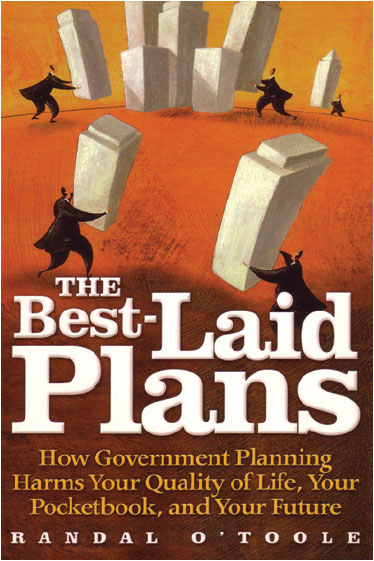
What am I talking about? The trappings of government planning — especially the kind where the object of the planning is other people. That means you. It’s a growth industry to be sure. The one thing that’s certain about it all is that government will be bigger after all is said and done, even when the planners fall short or fail, which they almost always do. That’s one important lesson among many from an important new book by researcher and Cato Institute scholar Randal O’Toole, "The Best-Laid Plans: How Government Planning Harms Your Quality of Life, Your Pocketbook, and Your Future."
O’Toole provides abundant evidence, case studies and examples from the United States and abroad, but if he had chosen to focus on Michigan alone, he would have found a cornucopia to demonstrate his points. Since Kim Sigler was governor 60 years ago, state government has piled one plan on top of another to "diversify" the economy, "stimulate" growth, attract this or that industry, or achieve some other grand design. Michigan law books contain nearly 58 separate statutes that have "economic development" purposes, replete with overlapping or duplicative policies that are scattered across state government. The Legislature almost never examines what’s in the books because that’s just not as attention-getting as piling on the next program.
In recent years, the centerpiece of such efforts in Michigan has been the Michigan Economic Development Corp. With the country’s highest outbound migration and unemployment rates, many Michiganians are wondering if the MEDC has been asleep at the switch.
Actually, one learns from O’Toole that although such planners are rarely sleeping, we would likely be better off if they were. Like so many other presumptuous agencies, the MEDC is less about ED (economic development) than it is about PR and self-promotion. As its agencies hold news conferences to pat themselves on the back, state government largely ignores the fundamentals of real growth. Last fall it even slapped a beleaguered state economy with a whopping tax hike.
Think of a state as a gigantic bad restaurant hemorrhaging customers. On the one hand, it can offer discounts or subsidies to a handful of customers if only they’ll stay and eat bad food at a high price. A better option would be to improve the menu and the service and cut the prices for everybody. Planners prefer the former approach because it empowers them to dole out favors to a few. But if that actually worked, Michigan’s sour economy is hardly evidence of it. O’Toole documents the jeopardy to our national forests from Forest Service planners; the exasperating traffic congestion motorists suffer because of urban planners; the displacement of inner-city families by housing planners; the threat to the environment from eco-planners; and a host of other errors writ large. "The bitter irony," he writes, ". . . is that many if not most of the problems the planners propose to solve were caused not by the free marketplace, but by past generations of planners and government bureaucrats."
It’s never enough, however, to simply find blame. One must offer solutions. O’Toole does precisely that, calling not only for repeal of many federal, state and local planning laws but also suggesting specific reforms that can fix stubborn problems without the heavy hand of mandates, edicts and bureaucracy. Privatization of services previously provided inefficiently by government is one such reform that many local governments and school districts have found to be a good economic development tool. Just as his earlier book, "The Vanishing Automobile and Other Urban Myths," has influenced decisions in important places, "The Best-Laid Plans" will likely prompt a rethinking of seldom-questioned planning myths across the country.
A copy of O’Toole’s book should be part of the severance package for MEDC planners.
State and local officials across Michigan can secure a copy of "The Best-Laid Plans" from the Mackinac Center for Public Policy for a special, discounted price of $15 postpaid. Limit one per person. Send check to Mackinac Center for Public Policy, P. O. Box 568, Midland, Mich., 48640.
Lawrence W. Reed is president of the Mackinac Center for Public Policy