


 Font size:
In order to keep a finger on the pulse of school privatization in Michigan, Mackinac Center for Public Policy staff follow regular news coverage of school support service outsourcing. This year’s news reports suggest more moderate privatization activity compared to last year. What has clearly increased, however, is the number of research papers published that attempt to cast privatization — and even Mackinac Center research — in a questionable light.
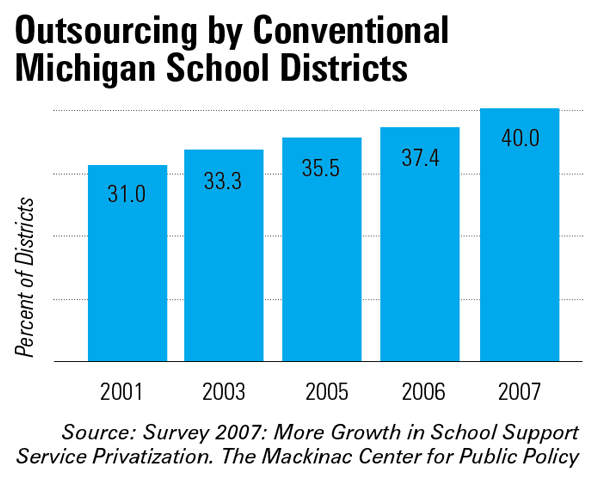
In each of the last four privatization surveys conducted by the Mackinac Center, the rate at which Michigan’s school districts outsourced at least one of the big three noninstructional services (food, janitorial or busing) had increased over the previous year. In 2001, 31 percent of conventional public school districts were contracting out; today it is 40 percent. According to the federal government’s Centers for Disease Control, the number of conventional and charter public schools nationwide contracting with food service management companies alone has leapt from 15.2 percent in 2000 to 20.4 percent in 2006. That is a staggering 34 percent rate increase.
The growing use of private vendors in public schools and the 2007 Mackinac Center privatization "how-to" manual, "A School Privatization Primer for Michigan School Officials, Media and Residents," may have spooked opponents of school contracting. No less than three Michigan-specific papers — all of which reference Mackinac Center work — have been released this year.
The first and arguably most enjoyable paper of the three was written by New York-based scholar Clive Belfield and published by the Lansing-based Great Lakes Center for Education Research and Practice. The seven-page report by Belfield is a somewhat flattering quasi-rebuttal of the Mackinac Center’s 107-page privatization primer. It concludes in part by saying: "This report is useful. It presents credible surveys of current policies across states showing that contracting out of food, transportation, and custodial services is widespread, although public provision is still more common."
This is not the entirety of his conclusion. He also argues, among other items, that the Center failed to examine such things as "transaction costs" in its analysis. This and other arguments made by Belfield are addressed in my rejoinder to his paper, "Privatization Review a Mixed Bag."
The other studies released this year are also easy to refute, but detailed analysis of each goes beyond the scope of this essay. One consistent suggestion made in each paper, however, is that support service privatization may not yield savings. That’s true enough. Virtually every human endeavor contains the possibility that the results will fall short of expectations. The question before us is, "are savings from doing privatization right probable?" The answer is a resounding yes.
Consider the increasing amount of anecdotal evidence in favor of savings. The Mackinac Center keeps a tally on per-pupil savings from privatization when the data is reported to us in various formats. We have recorded savings in all three categories from food service in Pinconning ($5.63 per pupil) to janitorial service in Harrison ($232 per pupil). Done right, contracting should save money every time.
Since our 2007 survey, media reports from around the state indicate that additional schools are using privatization to yield savings. This year Southfield Public Schools outsourced for custodial (including maintenance) and transportation services and are on the cusp of contracting for food services, too. They expect to save $21 million over three years for all three services. For more information on this and other anecdotal evidence, see "Statewide School Contracting Could Save As Much As $500 Million."
The Mackinac Center recognizes that no single metric, methodology or source is perfect. But to argue that privatization may not save money because there are no peer-reviewed empirical studies that say so, or that savings may not really and consistently accrue to schools because of "transaction costs," defies reasoned logic. It suggests that scores of school district employees and elected officials from around the state and country are unwilling or incapable of making sound financial decisions, or that they are acting in some sort of conspiracy to waste money. The Mackinac Center gives school boards more credit.
In the coming months readers will be able to find more detailed responses to published criticisms of support service privatization — as well as more survey research — involving rates of privatization and financial savings or losses where the data is available.
#####
Michael D. LaFaive is director of the Morey Fiscal Policy Initiative at the Mackinac Center for Public Policy, a research and educational institute headquartered in Midland, Mich. Permission to reprint in whole or in part is hereby granted, provided that the author and the Center are properly cited.
The Mackinac Center for Public Policy is a nonprofit research and educational institute that advances the principles of free markets and limited government. Through our research and education programs, we challenge government overreach and advocate for a free-market approach to public policy that frees people to realize their potential and dreams.
Please consider contributing to our work to advance a freer and more prosperous state.


