

 Font size:
This study analyzes a dispute between Hart Enterprises Inc., a medical device manufacturer located north of Grand Rapids, and the Michigan Department of Environmental Quality. The department alleges that Hart Enterprises’ property contains a nearly one-acre wetland — an area that lies in the way of the company’s proposed expansion of its parking lot. Because of the DEQ’s ruling, the department expects the company to request a wetland permit — request that might be denied, or that might be granted only with significant conditions attached.
Readers may view a supplemental video of Russ Harding interviewing Alan Taylor of Hart Enterprises.
It should have been a Michigan success story.
Hart Enterprises Inc., a medical device manufacturer with around 100 employees, is not the size of Ford or General Motors, but it has the feel of the future. Located on a grassy 9-acre plot in an industrial park north of Grand Rapids, Hart is headquartered in a low, rectangular building of green glass panels and tubular steel.
Inside, Hart Enterprises personnel design and manufacture specialty medical needles and customized medical devices. Parts of the facility look like the set of a science fiction movie. In clean-rooms, workers in lab coats, gloves and bouffant hairnets assemble and examine products under microscropes; in a high-tech manufacturing area, employees in blue smocks and safety glasses fabricate components.
The finished products are used by physicians in hospitals all over the world. The company has expanded from a handful of employees in 1981, when it moved to Michigan, to roughly 100 production personnel, quality inspectors and engineers. Alan Taylor, president and founder of Hart Enterprises, projects that total revenues over the next 25 years will reach $1 billion and that the company will grow to employ more than 500 workers.
For Taylor and Hart Vice President Robert Striebel, Michigan was part of the dream for this business. Although they had started the company in the Chicago area, they moved it to the Grand Rapids area because of the favorable labor market and because Michigan had so much of the hunting, fishing and outdoor recreation they enjoyed.
By the mid-1990s, the company had grown to around 50 employees. Hart Enterprises officials began scouting the company’s current site in the village of Sparta, about 15 minutes from Grand Rapids. In 1996, Taylor purchased the property and built Hart’s 46,000-square-foot complex and an 80-space parking lot for Hart’s employees, leaving four acres of land for future expansion. In 2006, when the original parking lot became too small, the company prepared to extend the lot, excavating approximately one-quarter of an acre at the lot’s western end.
And that’s when the company received a phone call that threw this success story into doubt. The driving force of an entrepreneur was about to collide with the damping force of a powerful agency enforcing a poorly crafted state wetland statute. The dispute sheds light on what the Legislature and governor must do to reform state wetland policy and protect the rights of Michigan property owners.
The call that sparked the conflict came on May 24, 2006, from a local representative of the Michigan Department of Environmental Quality. He informed the company that the DEQ had received a complaint that Hart’s parking lot expansion was filling a wetland. Since Michigan law typically requires a permit to alter wetlands, which are protected for environmental, agricultural and mining purposes, the representative asked to examine the area.[*][1]
He and Striebel met later that day and walked out to the parking lot. According to Striebel, the DEQ representative told him that the area being prepared for the parking lot expansion was indeed a wetland, but that the wetland would be regulated only if it emptied into, or was within 500 feet of, nearby drains or streams.[2]
The DEQ’s view that the area was a wetland surprised Taylor and Striebel. There had been no prior warning from the department, and the construction experts working on the property had not noted a wetland there. The DEQ’s subsequent conclusion that the area was indeed subject to regulation meant that from the agency’s perspective, Hart Enterprises would need to request a DEQ permit to use the land. Such a request might be denied, or it might be granted only with significant conditions attached.[†][3]
On July 12, 2006, the DEQ’s local representative sent Taylor a letter describing the base materials in the proposed paving area as "unauthorized activity" on "regulated wetlands." The letter stated that a permit was required for adding such fill material, advised Taylor to stop work and directed him to submit detailed information about the project to the DEQ.[4]
Given that the ground in question was already excavated and filled with base material for the parking lot expansion, Hart Enterprises finished the paving shortly after receiving the DEQ’s letter. Hart officials continue to feel that the DEQ has failed to provide a scientific basis for its wetland finding, and that by requesting a wetland permit, the company would implicitly concede the spot was a regulated wetland.[5]
More fundamentally, Hart officials have questioned the DEQ’s basic premise that the area is a wetland, observing that the ground is only occasionally wet, usually in the spring, and that it was long ago so altered by human engineering that its occasional wetness has little to do with nature. As Taylor puts it: "This is not a natural resource. This is a man-made mud puddle sitting in the middle of this industrial park that’s here to advance industry in the state of Michigan."[6]
Taylor is right to object. Nevertheless, understanding both his and the DEQ’s arguments is essential to grasping the shortcomings of Michigan’s wetland statute.[**]
[*] A permit to alter a wetland may not be required for some activities, such as construction of farm roads or improvement of public streets (see, for example, MCL 324.30305(2)). In addition, areas that satisfy the biological criteria for a “wetland” in the state’s wetland statute might not be regulated if they do not satisfy the statute’s other conditions, such as proximity to bodies of water (see MCL 324.30301(p)(i)-(iii)).
State law lists a number of benefits of wetlands: “flood and storm control,” “wildlife habitat,” “pollution treatment,” “erosion control,” sites for “the production of food and fiber” and “the extraction and processing of nonfuel minerals.” (See MCL 324.30302(b)-(d).)
[†] Whether Hart Enterprises should have had advance notice from the state of Michigan of the presence of a wetland on the property is discussed in “An ineffective wetland inventory."
[**] A statute is a law passed by the Michigan Legislature and signed by the governor. State regulations, in contrast, are drawn up by state executive departments, such as the DEQ. These regulations have the force of law only if a legislative statute grants a department the ability to develop them and if the department follows the administrative procedures established in state law. For more detail on the process state departments must follow in establishing binding rules and regulations, see the Michigan Administrative Procedures Act, MCL 24.201 et seq.
Begin with Taylor’s first point: The land in question doesn’t seem much like a wetland. A wetland is commonly thought of as a natural area featuring spongy soils and unusual vegetation and wildlife — a bog, a marsh or a swamp, with reeds, muskrats or frogs. Although Hart’s land is wet at times (see Graphic 1), it is hard-packed and dry for much of the year.
Moreover, the area hardly seems like a "natural resource." The parcel and the surrounding area were farmland until platted for development by an engineering firm in the 1980s. The property was purchased by Appletree Development Co., and Hart’s future parcel was later bought by William J. Antor & Sons Excavators, a developer that stripped the area of topsoil and replaced it with clay to provide a firm base for construction. The property was zoned industrial by the village.[7]
Thus, the land was set aside for — and subjected to — intensive development that included a new bed of relatively nonporous soil. Taylor and Striebel say that when they bought the site for Hart’s headquarters, the area in question, known as "Lot 7," had no standing water. (The DEQ does not confirm this point, but does not dispute it, either.)[*] The intermittent wetness on the lot in recent years is the result of nearby construction, which built up the surrounding soil. State highway M-37, running along an embankment to the west of Lot 7, helps block the westward flow of water, as does an embedded gas pipeline running from the north to the south-southwest. A Village of Sparta water tower, also on elevated ground, discourages the flow of surface water to the north. When Hart’s building and original parking lot were built to the east, Lot 7 was further boxed-in, making it harder for the area to drain, despite a man-made retention pond to the south and a ditch near the Applejack Court cul-de-sac to the north (see Graphic 2).[8]
Graphic 1
A Wet Portion of the Disputed Area
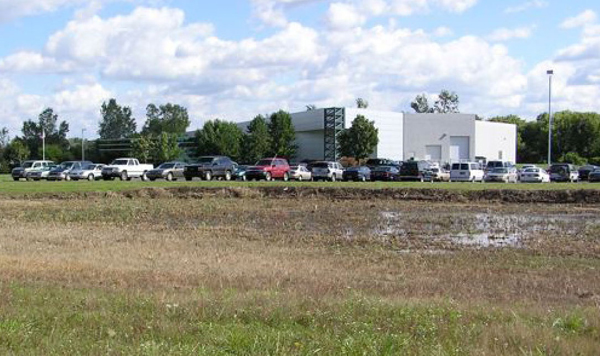
The photo shows land to the west of the Hart Enterprises parking lot in September 2006, following expansion of the parking lot earlier that summer. The area, known as Lot 7, was stripped of its topsoil in the early 1990s and bedded with clay. Construction activities throughout the area have left Lot 7 lower than the land immediately to the east, north and west. Photograph by the Mackinac Center for Public Policy.
Graphic 2
Diagram of the Area
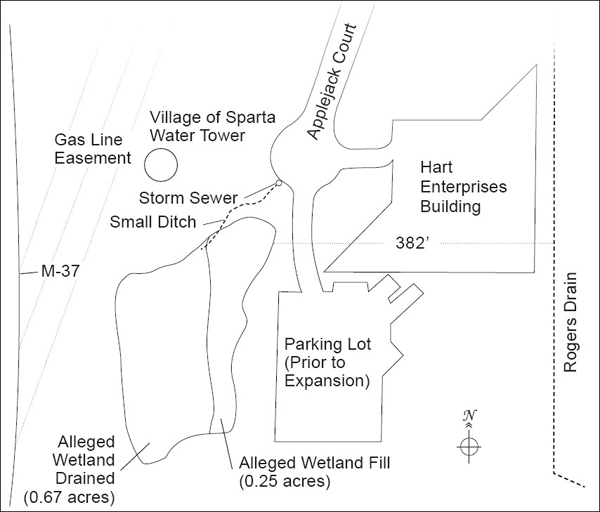
This diagram provides an approximate overview of Hart Enterprises’ property before the 2006 parking lot expansion. The parking lot was extended into the 0.25-acre area marked “wetland fill.” The DEQ also ruled that an additional 0.67 acres of Hart’s property to the west of the parking lot is wetland subject to regulation. The DEQ estimates a distance of 382 feet from the eastern edge of the alleged wetland to the Rogers Drain. Source: Mackinac Center composite of a DEQ map, a DEQ photo diagram and a map by WB Engineering Inc.
The DEQ’s letters to Taylor did not clarify why the department considered the area a wetland. The DEQ did refer him to a copy of the state’s lengthy wetland statute and quote general language from it to explain its jurisdiction, but it did not cite specific scientific evidence concerning soil, vegetation or wildlife.
Yet a professional can question whether Lot 7 is a wetland. Timothy Bureau, a natural resource consultant hired by Hart Enterprises after the dispute began, is a former regional representative and water quality specialist for the Michigan Department of Natural Resources, the state agency that originally enforced Michigan’s wetland law. He was also one of the first field staff hired by the DNR in 1978 to help administer the wetland statute. Bureau says: "A preliminary examination of the area raised serious questions about the soil’s wetland characteristics as well as the hydrology and wetland vegetation." Bureau also notes that snow from Hart’s parking lot is plowed to the lot’s western margin, increasing the volume of water that must drain from Lot 7 in the spring. The area’s standing water may owe more to a steel blade and a diesel engine than to wetland hydrology.[†][9]
Hart Enterprises also points to documents from construction firms that worked on the parking lot at various times. A 2006 report by Williams & Beck Inc., civil engineers whose business includes hydrogeological studies and water resource management, includes no concerns about a wetland in the area;[**] the same is true of a 1997 report by Hopper/Sheeran/Frank Inc., a group of geotechnical, environmental and construction materials engineers who monitored Hart’s original parking lot construction.[10]
Nor did the Village of Sparta note problems. In addition to zoning the area for industrial development, the village has approved Hart’s various construction projects.[11]
Taylor also observes that the DEQ (and earlier, the DNR) did not object to any of the construction in the area or the stripping of the topsoil. In particular, he stresses that the DNR did not flag any wetland on Lot 7 in 1990, when DNR staff determined that a wetland existed to the south of his current property.
This DNR finding appears less relevant (see "The DEQ’s viewpoint" below). Still, it seems clear that state government provided Taylor with no advance warning of the presence of a wetland on Lot 7 — an issue that will be explored in detail later.[‡]
And many other points remain true. Taylor bought property slated for industrial development; this property has been subjected to extensive human engineering; this engineering and construction, overseen by professionals familiar with water and soil issues, was not protested by local or state officials; and neither the DNR nor the DEQ warned that a wetland existed on the property before. Then, nearly 10 years after Taylor bought the property as a headquarters for a growing enterprise, he was told he could not use part of it because the DEQ had now declared that part to be a wetland subject to regulation.
[*] As one DEQ official put it, “We didn’t do an assessment of that property [before], so it’s our position that the impacts now are what we have to deal with.” (Elizabeth M. Browne, chief of the DEQ Land and Water Management Division, telephone interview with Diane Carey, February 20, 2008.) Other DEQ officials expressed a similar view.
[†] Bureau adds a legal point as well: He argues that the original topsoil was so sandy that the excavation by Antor & Sons qualified as sand mining, rendering any incidentally created wetland exempt from regulation under the state wetland statute. (See MCL 324.30305(4)(a); Timothy Bureau, telephone interview with Diane Carey, March 1, 2008.) This argument is not explored in the main text of this study.
[**] In the report, Williams & Beck did note “a very high seasonal water table,” but also remarked on “cohesive soils” (clay) and did not flag the area as a potential wetland.
The DEQ makes a variety of points in response. First, the department cites Michigan’s wetland statute, which states, "‘Wetland’ means land characterized by the presence of water at a frequency and duration sufficient to support, and that under normal circumstances does support, wetland vegetation or aquatic life. ..." Year-round water is not necessary under the law; rather the only prerequisite concerning the amount of water is a presence sufficient to host wetland life.[12]
The department is now reluctant to discuss any wetland vegetation found on the site, noting that this case may go to trial.[*] Indeed, the department’s physical specimens were obtained through a search warrant in October 2007, when two plant samples were taken and "a hydraulic connection with the lower clays was evaluated," says Jim Sygo, deputy director of the DEQ. "Sedges, reeds and cattails were found, among others."[13]
Whether these plants indicate the presence of a wetland depends on the species of sedge, reed or cattail. For instance, the "MDEQ Wetland Identification Manual" lists more than 150 types of sedge, some of which are found almost exclusively in uplands (slender wood sedge), and some of which are found almost exclusively in wetlands (soft-leaf sedge). Many others often occur in both environments.[14]
The DEQ is likewise now reluctant to discuss the area’s soil. In the eyes of the law, however, the soil type might not matter, since the definition of wetland in the state statute never explicitly mentions soil.[†] The DEQ’s wetland regulations, which typically have the force of law,[**] state that wetland determinations should rely primarily on the presence of water and wetland vegetation. Soil type is considered only to infer the presence of water when no water is visible. Given this regulation and the puddles on Hart’s property, the area’s clay soils might be ruled irrelevant in court if the DEQ produces sufficient evidence of wetland vegetation there.[15]
The DEQ’s correspondence did not provide Taylor with scientific evidence of a wetland on his property. In fact, nothing in the statute requires the department to provide such evidence.
DEQ officials also argue that Michigan’s wetland statute covers wet areas incidental to development, not just longstanding, natural wetland. Hence, says Elizabeth M. Browne, chief of the DEQ Land and Water Management Division: "If it takes on the qualities of what you’re calling a natural resource, to the plants and animals it has become a natural resource." In fact, this view of the statute has prevailed in court in a case similar to Hart’s.[16]
Given that property can evolve into wetland, DEQ officials say that property owners who want to build, pave, fill, create a berm or otherwise alter their land should apply for a wetland permit in advance, so the DEQ can assess the area before they begin construction. Property owners should also recognize that prior wetland assessments of their property may no longer be accurate. State law does direct the DEQ to refund the permit application fee if no wetland is found in the area.[17]
Indeed, even if the 1990 DNR finding of a wetland south of Taylor’s property had also declared Hart’s property wetland-free, that assessment would not appear to bind the DEQ now, given past and present wetland statutes.[‡] And the DEQ disputes Taylor’s reference to the DNR assessment, saying this finding involved only the area to the south of Hart’s current property — not Hart’s property itself.[18]
As a final argument, DEQ officials observe that laymen — and sometimes even people with professional credentials — may have trouble recognizing a regulated wetland. As Sygo says, "[Lot 7]’s a low-quality wetland, but nonetheless it complies with what we believe to be a wetland." He adds, "It’s difficult for any lay person to look at an area and try to decide whether it’s a wetland or not [because] there are just so many determining factors." Browne also points to complexity, saying: "Each site is evaluated on its own characteristics. There are soil types [and] lists of plant species, and inspectors are not built out of the same mold. ... We try to work with ... local units of government, local approvers of things, to at least get them educated enough to raise the questions [about possible wetland] to the homeowner. ..."[19]
"There’s absolutely nothing black and white about it," says Peg Bostwick, supervisor of the Wetlands, Lakes, and Streams Unit of the DEQ’s Land and Water Management Division. "There’ve been repeated attempts to try to boil it down into something — a model where you can just feed in a bunch of statistics and come up with the answer. ... But it’s impossible. We try to come up with the guidance [and] methods to be as consistent as possible in our decision-making, but a lot of it is a judgment call, and it comes down to staff expertise and training. ...There’s a great deal of judgment about it."[20]
[*] Government attorneys typically recommend that departments cease discussing the details of a case in public if the case is likely to be litigated.
[†] There is a plausible legal argument, however, that soil is mentioned indirectly in the statute’s reference to a “bog, swamp, or marsh.” See ‘Wetland.’
[**] Regulations promulgated by executive agencies like the DEQ can be overruled by the courts or nullified by a legislative rewriting of the statute on which the regulations are based.
[‡] The wetland statute in force in 1990, Public Act 203 of 1979, did not provide any lasting force to DNR declarations of an absence of wetlands. The current statute, which was enacted in 1994, provides that the DEQ must honor any formal DEQ declaration of an absence of wetland for three years. (See MCL 324.30321(4)(c).) This three-year rule, however, applies only to DEQ assessments made before the department completes an inventory of the wetlands in a particular county. The DEQ now claims to have completed such an inventory for all Michigan counties. (As discussed in “An ineffective wetland inventory," this claim is questionable.)
Michigan’s wetland statute defines a "wetland" only briefly and in general terms. Unsurprisingly, this definition generates a great deal of dispute. The DEQ itself acknowledges the complexity of wetland determinations.
Indeed, the DEQ holds that homeowners and business owners should not assume they can build on their property just because it doesn’t seem like a wetland. Wetland, in this view, is inherently difficult to identify; it may emerge over a few years as a by-product of human activity on adjacent properties; and only DEQ experts can safely decide whether property is a regulated wetland. Property owners hoping to build should apply for a DEQ wetland permit first to avoid inadvertently breaking the law.[*]
This view reduces a property right to something more like a license. But given the valuable role property rights have played in our society, it’s worth exploring whether the DEQ is correct to imply that its approach to wetland regulation is compelled by Michigan law.
[*] This appears to be a longstanding view of the agencies enforcing the wetland statute. In a 1992 ruling in Iosco County Court, Circuit Court Judge J. Richard Ernst quotes an exchange between the trial court judge and a prosecutor regarding how a person might know when he or she was about to violate the wetland statute:
THE COURT: * * * (H)ow does a person know [that] when to follow the law is really what the question comes to?
[PROSECUTOR]: They contact the DNR to determine whether a permit is necessary, your Honor.
THE COURT: The statute says you have to apply for a permit to fill a wetland.
[PROSECUTOR]: That’s correct, your Honor.
THE COURT: And then you find out if you needed to apply by finding out whether they tell you its [sic] a wetland or not? What I’m looking for is how does a person know if they are within the law other than do they just call the DNR and ask for their opinion, is that what your [sic] saying?
[PROSECUTOR]: Contact the Department of Natural Resources. Someone would go out, examine the land, make a decision whether a permit was necessary or not, your Honor.
Judge Ernst continued: "If the law is as argued by the prosecutor, a preliminary determination by a DNR employee whether or not a particular parcel is a Goemaere-Anderson [i.e., statutory] ‘wetland’ has become a necessary prerequisite to any improvement of land, if an unwitting violation of the Act is to be avoided." (See People v. Macintosh, No. 91-7917-AR (Iosco County Circuit, June 8, 1992).)
In a letter to Taylor dated Dec. 28, 2007, a DEQ official justifies the DEQ’s regulation of Lot 7 by citing two conditions from the wetland statute:
As defined in Section 30301(p)(i) a wetland is "... land characterized by the presence of water at a frequency and duration sufficient to support, and that under normal circumstances does support, wetland vegetation or aquatic life, .... "and is contiguous to the Great Lakes, an inland lake or pond, or a river or stream.["][*]
[Both ellipses ("...") appear in original.][21]
As noted earlier, the DEQ believes Lot 7 meets the first condition concerning "sufficient" water. The department concludes Lot 7 meets the second condition "because the wetland is located within 500 feet of the Rogers Drain[,] which is a stream as defined by Part 301, Inland Lakes and Streams, of the NREPA [Michigan Natural Resources and Environmental Protection Act]."[22]
But the idea that a wetland and a stream are contiguous simply because they lie within 500 feet of each other — not because a connection has been found between them — does not appear in the wetland statute. Rather, the 500-foot rule appears in DEQ regulations interpreting the statute. Since the DEQ wrote these regulations, it could have defined "contiguous" to mean "adjacent" or "sharing a significant hydrological connection."[†] The department had more leeway than it suggests.[23]
Nor does the wetland statute indicate that a drainage ditch like the Rogers Drain (see Graphic 2, Page 5) is a "stream." This definition, according to the DEQ’s letter, proceeds from Part 301 of the state’s environmental laws.
This may seem odd, since Part 301 is entirely separate from the wetland statute (known as "Part 303"); they are different legislative acts. Still, a plausible legal argument can be made that Part 301’s definitions should be reconciled with the language in the wetland statute, since both acts deal with waters of the state.[**]
Even if Part 301 is considered relevant, it’s unclear that the DEQ’s view of a drain as a stream would follow from the Legislature’s definitions there. The only mention of drains in Part 301 is, "‘Inland lake or stream’ means a natural or artificial lake, pond, or impoundment; a river, stream, or creek which may or may not be serving as a drain as defined by the drain code of 1956. ..."
But the fact that a stream can serve as a drain doesn’t mean a drain is a stream. After all, the fact that a school can serve as a polling place doesn’t mean a polling place is a school. In fact, if the Legislature saw streams as natural and drains as either man-made or natural (a common view), a man-made drain might never be a stream under Part 301.[‡][24]
And Part 301 specifically focuses on large bodies of water and excludes small ones. It is therefore not clear that under Part 301 a relatively minor geographical feature like the Rogers Drain should be considered a "body of water" with a "continued occurrence of water." Rogers Drain is an ordinary open man-made ditch, sometimes with flowing water; sometimes with puddles of standing water; and sometimes dry. That such ditches should be considered "streams" is no clearer in Part 301 than it is in the wetland statute.[25]
Finally, it should be noted that the DEQ’s own wetland regulations do not copy the definition of rivers and streams from Part 301, and that the DEQ’s regulations don’t appear to include drains as streams either. In these regulations, an inland river or stream is somewhat circularly defined as "[a] river or stream which has definite banks, a bed, and visible evidence of a continued flow or continued occurrence of water."[26]
Even if one defined "a continued occurrence of water" to include a ditch that sometimes contains very little water at all, this regulation remains silent about drains and ditches. Rather, the regulation equates an inland river or stream to a "river or stream" with the properties listed ("definite banks, a bed," etc); it never mentions other bodies of water or man-made drains. In short, the regulation contains nothing to suggest why the Rogers Drain would be a stream.
[*] The unnecessary second open quotation mark appears in the original.
[†] There is one case in which a 500-foot proximity isn’t enough to establish “contiguity,” but it occurs only when the DEQ engages in an unusual procedure to protect a smaller “essential” wetland and affirmatively establishes that no surface water or groundwater connection exists between a wetland and a body of water:
(iii) A wetland is partially or entirely located within 500 feet of the ordinary high watermark of an inland lake or pond or a river or stream or is within 1,000 feet of the ordinary high watermark of one of the Great Lakes or Lake St. Clair, unless it is determined by the department, pursuant to R 281.924(4), that there is no surface water or groundwater connection to these waters.
(See Mich. Admin. Code r. 281.921(b)(iii); Mich. Admin. Code r. 281.924(4) is a regulation dealing with “essential” wetlands that would not otherwise be covered by the statute.) The DEQ defines “contiguous” to include either the 500-foot proximity described immediately above or those cases involving a permanent water connection or an intermittent surface water connection to inland lakes, ponds, rivers or streams. (See Mich. Admin. Code r. 281.921(b)(i)-(ii).) Note that a 500-foot rule does appear in another statute, where the Legislature stipulates that a permit is required whenever work on an artificial waterway occurs within 500 feet of an inland lake or stream (see MCL 324.30102(f)).
[**] This legal view, formally known as “in pari materia,” is not entirely convincing, however. Both Part 301 and Part 303 begin with definitions prefaced by the words, “As used in this part: …” (see MCL 324.30101; MCL 324.30301(a)-(p)(iii)). This language would suggest an “in pari materia” reading of the two laws’ definitions might be inappropriate, since courts are supposed to assume the Legislature means what it says when it speaks clearly. Moreover, Part 301 is not the only other statute involving waters of the state; there is also Part 305, known as the “Natural Rivers Act.” Notably, Part 305 defines a river as “a flowing body of water or a portion or tributary of a flowing body of water, including streams, creeks, or impoundments and small lakes thereon.” This definition, which mentions streams, would not seem to include intermittently flowing drains, such as the Rogers Drain flanking Hart’s property. In short, “in pari materia” may offer little guidance in this case, since the various acts do not easily reconcile. In any event, the DEQ again appears to have had latitude in formulating wetland regulations; it was not forced by law to conclude a drain is a stream.
[‡] Note that while the language “natural or artificial” clearly applies to “lake, pond, or impoundment,” it does not clearly apply to “a river, stream, or creek,” which may have been commonly understood to be natural.
Someone convinced that drains should be included in the definition of streams might point to Part 301’s statement that an inland lake or stream is also “any other body of water that has definite banks, a bed, and visible evidence of a continued flow or continued occurrence of water, including the St. Marys, St. Clair, and Detroit rivers.”
Yet even this interpretation would depend on tenuous claims that an occasionally flowing ditch is a “body of water” with a “continued occurrence of water.” These distinctions would in turn have to contend with the fact that Part 301 specifically includes major rivers, but specifically excludes smaller bodies of water, such as “a lake or pond that has a surface area of less than 5 acres.” (See MCL 324.30101(h).) The Rogers Drain seems more like the small bodies of water that Part 301 excludes, not the major rivers that Part 301 specifically includes.
If the DEQ’s definition of "contiguous" to a "stream" seems expansive, so does its interpretation of the definition of a wetland. Consider again the description the DEQ gave Taylor about why Hart’s property was subject to regulation:
As defined in Section 30301(p)(i) a wetland is "… land characterized by the presence of water at a frequency and duration sufficient to support, and that under normal circumstances does support, wetland vegetation or aquatic life, .... "and is contiguous to the Great Lakes, an inland lake or pond, or a river or stream. ["][27]
The second ellipsis, like the first ellipsis, appears in the original, and it is important. The second ellipsis shows where the department omitted a part of the wetland definition between "aquatic life" and "and is contiguous. ..." The missing language is an additional condition: "and is commonly referred to as a bog, swamp, or marsh. …" (The complete statutory definition of a wetland appears in Graphic 3.)[28]
This additional part of the definition of wetland is significant. An area might easily be wet enough to support "wetland vegetation" (which can often be found in nonwetlands) without being "commonly referred to as a bog, swamp, or marsh." In particular, this language wouldn’t describe Hart’s Lot 7, which doesn’t have the spongy, saturated soils or the abundant wetland flora and fauna that are part of the common understanding of bogs, marshes and swamps. Given this additional condition in the wetland definition, it’s unlikely that a wetland exists on Hart’s property.[*]
Graphic 3
“Wetland” as Defined by the Michigan Legislature[†]
|
(p) "Wetland" means land characterized by the presence of water at a frequency and duration sufficient to support, and that under normal circumstances does support, wetland vegetation or aquatic life, and is commonly referred to as a bog, swamp, or marsh and which is any of the following: (i) Contiguous to the Great Lakes or Lake St. Clair, an inland lake or pond, or a river or stream. (ii) Not contiguous to the Great Lakes, an inland lake or pond, or a river or stream; and more than 5 acres in size; except this subparagraph shall not be of effect, except for the purpose of inventorying, in counties of less than 100,000 population until the department certifies to the commission it has substantially completed its inventory of wetlands in that county. (iii) Not contiguous to the Great Lakes, an inland lake or pond, or a river or stream; and 5 acres or less in size if the department determines that protection of the area is essential to the preservation of the natural resources of the state from pollution, impairment, or destruction and the department has so notified the owner; except this subparagraph may be utilized regardless of wetland size in a county in which subparagraph (ii) is of no effect; except for the purpose of inventorying, at the time. Source: This definition appears in MCL § 324.30301(p)(i)-(iii). The Department of Environmental Quality cites part (i) of the definition in claiming regulatory authority over the 0.92-acre portion of Hart Enterprises’ Lot 7. (Because the DEQ states that it has completed a wetland inventory for all Michigan counties, the department claims full power under parts (ii) and (iii). See "An ineffective wetland inventory" below.) |
[*] Some may argue that this second condition was meant simply as examples of wetlands, rather than represent an additional condition. But if the Legislature meant a bog, swamp or marsh to serve as an example, the Legislature could have prefaced the phrase with “for example” or with “or,” rather than with “and.” In fact, the DEQ reads “and” as meaning “and” just a few words later in the statute: In the letter quoted above, the department takes the “and” before “is contiguous” to mean that both the first and last conditions must be satisfied in order to establish the presence of a regulated wetland. But if that “and” means that the first and the third conditions must be satisfied, the previous “and” would inevitably mean the second condition must be satisfied too.
The legal conclusions drawn in this case study about the words “contiguous” and “wetland” may not match those of the DEQ, but they are similar to conclusions reached by Iosco County Circuit Court Judge J. Richard Ernst in the 1992 case People v. Macintosh (see footnote for The Impact of Definitions.) Judge Ernst used straightforward readings of “wetland” and “contiguous” to dismiss the charges against a defendant accused of building a road through an area designated as a wetland by the DNR.
[†] Michigan statutes are available online at
www.legislature.mi.gov/(S(mw5jsr55xtkfw5b20eknuq2e))/ mileg.aspx?page=MCLBasicSearch
Does this mean the DEQ is off-base in its view of Michigan wetland law? Arguably yes, though it should be remembered that the department has the difficult job of creating practical rules for a poorly defined statute and making those rules consistent with other laws.[*] At the very least, however, it’s clear that other reasonable readings of Michigan’s wetland statute — particularly of the words "contiguous," "stream" and "wetland" — would have placed Hart Enterprises’ property outside the wetland statute’s jurisdiction.
What’s also clear is that if the DEQ’s reading of any one term in the statute is expansive, the statute’s reach becomes very broad indeed when several expansive terms are taken together. "Wetlands" that are not bogs, swamps or marshes and that lie within 500 feet of a qualifying drainage ditch can cover, literally, a lot of ground.
In fairness, the DEQ is hardly alone in this approach. The author has worked with regulatory agencies in several different states, and he observed this tendency in each of them. After all, any agency that reads its powers narrowly doesn’t just limit its own staff and budget; it leaves itself open to accusations by activists and politicians that it’s shirking its duty. No one likes to be charged with that.
Ultimately, the real problem lies with the original statute. Legislators cannot be surprised to see the DEQ fill the legal void when they give the department the power to "promulgate and enforce rules to implement" a wetland statute whose most fundamental terms are debatable. "Wetland," "stream," "lake," "pond," "contiguous," "vegetation" and "aquatic life" were all inadequately defined.[29]
The statute also requires the department to make broad assessments of the "public interest" and to use these assessments to determine whether a particular permit will cause "an unacceptable disruption" to the state’s aquatic resources. Such sweeping determinations should never be left to an executive agency: They set up an executive department to be a legislature, prosecutor and judge. Under such circumstances, it’s no wonder that Alan Taylor — or any resident — might feel the department has too much power.[†][30]
[*] Indeed, when the DEQ is questioned about its interpretations of state wetland law, the department often states that the Michigan Legislature expects the department to read the statute in ways that enable Michigan to maintain its special status under federal wetland law. Basically, this status means Michigan is currently one of two states where federal permits are not required when people wish to modify areas considered wetlands under federal law; state permits suffice. Michigan qualified for this status by meeting certain legal requirements and convincing the U.S. Environmental Protection Agency that the state’s wetland law is sufficiently stringent.
But a concern over federal permits does not in fact provide a legal basis for the DEQ to interpret the state wetland statute in light of federal requirements. Nothing in the state wetland statute (or in the original 1979 state wetland statute) refers to state administration of federal permits or otherwise suggests the DEQ should maintain Michigan’s federal permit status. If the wetland statute must be modified to meet federal requirements, only the Michigan Legislature — not the DEQ — can do so. (See 1979 Public Act 203, which is the original wetland statute. The only part of that statute that might be considered relevant to federal wetland permits is a reference to the state’s making “contracts with the federal government” and others for “the purposes of making studies” to promote better wetland management. But these “studies” cannot be construed as federal wetland permits, especially contrasted with how extensively and explicitly the state Legislature describes the proper handling of municipal wetland ordinances and permits. See 1979 Public Act 203, MCL 281.704 (repealed 1995) and MCL 281.708(4) (repealed 1995).)
[†] The permit portion of the wetland statute repeatedly requires the DEQ to make broad policy decisions. The department is told to determine whether a particular wetland permit will be in the “public interest,” to weigh “the benefit” against “the forseeable detriments,” and to consider “the relative extent of the public and private need.” The DEQ is also expected to evaluate “the availability of feasible and prudent alternatives,” the recommendations of other state agencies, and the “economic value, both public and private, of the proposed land change.” (See generally MCL 324.30311(1)-(3).)
Such a widespread balancing of societal and individual interests is precisely what legislators are elected to do. An executive agency can occasionally help administer the details of a particular law, but as the Michigan Supreme Court has noted, “Policy determinations are fundamentally a legislative function.” (Blank v. Department of Corrections, 462 Mich 103, 116 (2000); see generally Michigan Constitution of 1963, Article 3, Section 2.) Hence, the wetland statute’s permit provisions might be unconstitutional under the state constitution’s separation-of-powers clause, according to Patrick J. Wright, senior legal analyst for the Mackinac Center for Public Policy.
Nor does it seem fair and efficient to pass a wetland law that people cannot know they are breaking without a prior assessment from the DEQ. The Legislature appeared to address this concern in the statute by directing the department to "issue a final [wetland] inventory which shall be sent [to] and kept by the agricultural extension office, register of deeds, and county clerk." This inventory was to cover "all wetland in this state on a county by county basis." In theory, such an inventory would have allowed Hart Enterprises to anticipate the current dispute before it arose.[31]
The DEQ did certify that it had completed a statewide wetland inventory in January 2007. According to a DEQ Web site, the inventory is a set of county maps that combine data from the U.S. Fish and Wildlife Service’s National Wetland Inventory, the Michigan Department of Natural Resources’ Michigan Resource Inventory System, and soil maps from the U.S. Department of Agriculture’s Natural Resource Conservation Service.[*][32]
Although these sources are reputable, they involve aerial photography and soil surveys, not on-the-ground wetland assessment. As a result, the DEQ’s maps cannot tell a landowner or prospective buyer whether he or she actually has a wetland. As the DEQ states: "The maps may not identify all potential wetlands in a county. It [sic] may show wetlands that are not actually present and it may not show wetlands which are actually present." A clear determination of "specific locations and jurisdictional boundaries of wetlands for regulatory purposes" requires "on-site evaluation performed by the DEQ. ..."[†][33]
The statute contains numerous indications that the Legislature intended these maps to provide a definitive wetland assessment. If so, the Legislature failed to mandate that outcome explicitly. Given this, perhaps it isn’t surprising that the "inventory" that was produced is of very limited value.[**]
[*] Soil maps are aerial photographs supplemented by soil samples on the ground.
[†] In the case of Hart Enterprises, the Mackinac Center’s attempt to locate the property on the DEQ’s inventory of Kent County tentatively places it outside of any apparent state or national wetland area. The property does lie inside a zone marked “soil areas that include wetland soils,” but particularly given that the natural topsoil for Hart’s property had been replaced with clay, this designation does not serve as a meaningful warning that the property would be identified as a wetland by the DEQ.
[**] There are several provisions in the wetland statute that suggest the Legislature intended the maps to provide an accurate, legally enforceable guide for residents. For instance, the statute requires a public comment period before the “preliminary” inventory is published as final. The final maps are then to be made available to the public through county clerks, registers of deeds and state legislators, with property owners being informed of a possible change in the wetland status of their property through their property assessment notices. In addition, the statute allows a property owner to ask the DEQ for a timely, definitive on-site wetland assessment of his or her property — but only before the final inventory is completed, not after. A pre-inventory assessment that finds no wetland on the property is to be binding on the DEQ for three years. Such provisions are difficult to understand if the final inventory wasn’t meant to be fixed and reliable. (See MCL 324.30321(1)-(4) and MCL 324.30322.)
State legislators have produced a wetland statute that is bad law, no matter what its good environmental intentions. The Legislature’s failure to define key terms and its broad grants of power to the DEQ have left the law overbroad and experts divided.
These failures put Alan Taylor, who objects to the law’s seemingly arbitrary results, in murky waters. In October 2007, the DEQ obtained a search warrant and arrived at Hart Enterprises escorted by police. The department’s staff inspected the area and took the vegetation and other samples referred to earlier (see "The DEQ’s viewpoint," Page 6). On Dec. 20, 2007, the DEQ met with Taylor at Hart Enterprises, and on Dec. 28, 2007, and Jan. 4, 2008, the department sent Taylor letters reiterating its view that the area into which Hart Enterprises had expanded the parking lot in 2006 was a wetland, and that the expansion had violated the law. The agency also noted that approximately 0.67 acres of wetland remained to the west of the expanded lot, and that Taylor would need to apply for a wetland permit in the future if he hoped to expand his parking lot to the west again.[34]
The letter of Jan. 4 also stepped up the department’s enforcement, advising Taylor "to discontinue any unauthorized activity within the regulated wetland and bring the site into compliance with [the wetland statute] within 30-days from the date of this letter." To comply, the letter continued, Hart Enterprises should "remove all fill from the regulated wetland," so that the area is "restored to its pre-fill contours with all fill material removed such as to expose the original soil beneath the fill." In short, Hart Enterprises is being told to rip up the parking area it paved in 2006.[*][35]
The case may now end up in court. Civil and criminal charges could be leveled against the firm.[36]
How the dispute will end is hard to tell. What’s clear is that Taylor’s affection for Michigan has been overshadowed by this struggle over the use of his land. He calls the state’s wetland process "bad government" and labels the DEQ’s insistence that he apply for a wetland permit "coercive intimidation."[37]
Hart Enterprises’ future here is now uncertain. In a letter to state Sen. Wayne Kuipers on July 28, 2006, Striebel wrote: "[T]he state would deprive us of all use of the remainder of our property now required for our expansion. Should the MDEQ prevail in their attempts to deny our use of this property, we will be forced to move our operation, and we can assure you that should that occur, we won’t remain in the State of Michigan!"[38]
[*] The letter contained a second condition: “Also, the small ditch draining the wetland ... must be filled to original grade with sufficient material to prevent draining of the wetland through the ditch.”
The possibility of driving away businesses is only one of the costs of the shortcomings of Michigan’s wetland law. Another is that homeowners and business owners alike face a law that makes planning difficult and imposes new costs and uncertainties on expanding a home or business.
Such uncertainty devalues property rights, since a "right" which an individual must always ask permission to exercise is more like a privilege, especially when it is granted by an agency of unelected officials who cannot describe a concrete method by which they grant their approval. It is no slur on the motives or professionalism of DEQ staff to say that the Legislature should never hand a department this sort of power.
Our wetland regime also affects Michigan’s economy. Many states have relatively flexible wetland regulation, and very few have our abundance of freshwater lakes, rivers, streams and ponds. As a result, a landowner is much likelier to run afoul of a wetland statute here than elsewhere. This risk lowers the value of property and businesses in Michigan and makes the state less attractive to investors. In the case of Hart Enterprises, the threat may drive out scores of the "high-skilled, high-wage jobs in emerging, technology-based industries" that Gov. Jennifer Granholm and others praise.[39]
At the same time, the DEQ’s broad interpretation of the statute is environmentally counterproductive. Small patches of land with a few wetland characteristics do not produce a true wetland’s environmental benefits, such as biological and chemical oxidation. In fact, a DEQ study of man-made wetlands designed specifically for environmental purposes found that many were ineffective over time. Wet areas incidental to human activity are even less likely to provide ecological value, and protecting them drains DEQ resources from meaningful goals, such as the preservation of true wetlands.[40]
State legislators should recognize that they have produced a statute that is sidetracked from its intended purpose, weakening the state’s economy and producing uncertainties that are unfair to property owners, most of whom can’t afford to fight for their rights in court. To address these concerns, the Legislature should consider the following reforms.
The statute currently exempts “a wetland that is incidentally created” by a few specific mining and construction activities.[*] This exemption should be generalized to include other human construction and activities whose primary purpose is not the creation of a wetland.[41]
Exempting wetlands incidental to human activity is appropriate for a state like Michigan, which already has numerous wetlands and freshwater resources. Nor would Michigan be alone in doing so. The state of Washington, for instance, has the following provision in its wetland law:
Wetlands do not include those artificial wetlands intentionally created from nonwetland sites, including, but not limited to, irrigation and drainage ditches, grass-lined swales, canals, detention facilities, wastewater treatment facilities, farm ponds, and landscape amenities, or those wetlands … unintentionally created as a result of the construction of a road, street, or highway.[42]
[*] The state wetland statute also allows many agricultural, infrastructural and outdoor activities to occur on a regulated wetland without a permit. (See MCL 324.30305(1)-(3).)
As noted earlier in "‘Contiguous’ to a ‘Stream’," classifying the Rogers Drain as a stream is a stretch. Yet the logic that labels that drain a stream — and thus a basis for regulating any "wetland" within 500 feet of the ditch’s entire length — would apply to many of the man-made drainage ditches in the state, including the ditches that commonly border Michigan’s roads.
Policymakers should recognize just how sweeping the law becomes under this definition. The swath of land 500 feet to the left and right of a ditch covers 1000 feet, or nearly one-fifth of a mile, for the entire length of any ditch considered a stream. The result is a considerable chunk of land within reach of wetland regulation, especially considering the number of roadside ditches and roadside homes in Michigan.[*]
The Legislature should specifically clarify that intermittently flowing ditches are not streams for the purposes of the act. This modification may be the single most important statutory change the Legislature could make in restoring the original intent of the act and keeping regulatory agencies from gaining a veto power over huge amounts of personal property throughout the state.[†]
Michigan has numerous natural inland lakes, rivers, streams and ponds. Regulating wetlands that have a genuine hydrological connection to these bodies of water will amply protect the state’s wetlands and natural resources.
[*] Consider, for instance, that the Lenawee County Drain Commissioner estimates that the county contains about 1,150 miles of open drains in the county’s inventory. (Stephen R. May, e-mail to Diane Carey, February 19, 2008.) If they, like the Rogers Drain, qualified as streams under the DEQ’s reading of the law, any area designated a wetland within 500 feet of these drains would be subject to regulation. This is not a trivial amount of land in a county of 761 square miles, even if many of the 500-foot areas around the drains overlap. After all, these zones are only part of what would be regulated; any additional land within 500 feet of natural rivers, streams, ponds and lakes would be regulated, too.
[†] Some may argue that even when a ditch flows intermittently, it might ultimately connect in some way to a natural body of water, thereby providing an occasional possible link between that resource and an area designated as a wetland. But many of these physical, hydrological connections are very tenuous. If such remote connections become the basis for regulating land, all of Michigan could be placed under regulation — in which case, the Legislature could have written a very brief law.
The Legislature should create working definitions of the key scientific terms in the statute. The definitions can, of course, be informed by expert testimony. Ideally, wetlands should be limited to the marshes, bogs and swamps mentioned in the current legislation, and these should be described in the statute, including some reference to the type of soils included.
State legislators should, for instance, consider adopting the federal wetland definition. This definition is not perfect, but it does at least refer to soil types as a primary indicator of the presence of a wetland. Adopting the federal definition would have the added benefit of making Michigan’s wetland definition consistent with those in most of the rest of the country.
Similarly, inland "lakes, rivers, streams and ponds" should be defined as natural bodies of water, while "contiguous" bodies of water should be adjacent or in actual physical contact.[43]
These changes will ensure that the state’s regulators are expending their resources on areas that provide genuine environmental benefits, not areas similar to what even the DEQ calls the "low-quality wetland" at Hart Enterprises. Better definitions will also increase the chances that informed citizens and private experts will be able to know a wetland when they see it. The current system, in which a property owner can only know whether his or her property contains a wetland by applying to the DEQ for a permit, risks creating a rule of men, not of laws.
For the same reason, the Legislature should remove all references to the DEQ’s determining items like "the public interest," "public and private need" and an "unacceptable disruption" to aquatic resources. Defining such terms is the very purpose of an elected Legislature. It is not the right work for an unelected government agency.[44]
The inaccuracy of the state’s current wetland inventory makes it of little value to Michigan residents and businesses. The inventory is based only on aerial photography and on soil maps, which are themselves dependent on aerial photos. The result is inadequate.
The Legislature should require and finance a comprehensive state wetland inventory based on an on-the-ground survey. The survey’s findings should be considered definitive, allowing the state’s residents and businesses to know whether the property they are buying or building on contains regulated wetland.
The result would be fairer to residents and would encourage investment in the state by providing the predictability that businesses seek. Producing such an inventory should not be expensive if the DEQ assigns the task to personnel currently "protecting" wet areas of little value.
Regardless, the Legislature should stipulate that the DEQ’s current inventory is not a sufficient basis for invoking MCL 324.30301(p)(ii) and regulating noncontiguous wetlands larger than 5 acres in counties with a population of less than 100,000. Such regulation is unfair to the residents of those counties given the shortcomings of the present inventory. Moreover, the DEQ should not be allowed to use its own policy failure as grounds for increasing its power.
For more than a century, Michigan’s water resources have been a wellspring of environmental and economic benefit to the state. Protecting these resources is important.
But the current interpretation of Michigan wetland law ignores the dramatic improvements in water quality and environmental safeguards in recent decades. Worse, it threatens to turn a pursuit for nebulous environmental benefits into a weapon against the people’s rights and prosperity. The dispute over the “wetland” at Hart Enterprises is simply one example of this.
Michigan policymakers should recognize the need to reform the state’s wetland statute. A failure to act will make the state less attractive, less prosperous and — since Michigan will probably behave like other poorer regions — less concerned about the environment. Reform, on the other hand, will make the state’s wetland policy what the Hart Enterprises story should have been and could still become: a true Michigan success story.
1 Robert Striebel, vice president of Hart Enterprises Inc., telephone interview with Diane Carey, February 15, 2008; MCL 324.30301-30323.
2 Striebel, telephone interview with Carey, February 15, 2008.
3 Robert C. Day, district representative of the Land and Water Management Division of the Michigan Department of Environmental Quality, letter to Alan Taylor, president of Hart Enterprises Inc., July 12, 2006; MCL 324.30306; MCL 324.30311.
4 Jim Sygo, deputy director of the Michigan Department of Environmental Quality, letter to Alan Taylor, president of Hart Enterprises Inc., December 28, 2007; Day, letter to Taylor, July 12, 2006.
5 Alan Taylor, president of Hart Enterprises Inc., interview with Diane Carey, December 20, 2007; Michael T. Williams, Williams & Beck Inc., "Report Regarding Construction of Parking Lot Addition," to Steve Gladu, Hart Enterprises materials manager, August 3, 2006.
6 "The Hart Enterprises Wetlands Dispute: Russ Harding interviews Alan Taylor of Hart Enterprises" (Mackinac Center for Public Policy, 2007), www.mackinac.org/9038 (accessed June 3, 2008).
7 Taylor, interview with Carey, December 20, 2007; "Apple Tree Development Lot 7[:] a History," (Hart Enterprises Inc., 2007, photocopy); Sharon DeLange, Sparta village manager and finance director, telephone interview with Diane Carey, February 20, 2008.
8 Timothy Bureau, telephone interview with Diane Carey,
January 4, 2008.
9 Bureau, telephone interview with Carey, January 4, 2008; Timothy Bureau, telephone interview with Diane Carey, February 29, 2008; Timothy Bureau, telephone interview with Tom Shull, May 28, 2008.
10 Williams, "Report Regarding Construction," August 3, 2006; Donald N. Hopper, Hopper/Sheeran/Frank Inc., reports to Alan Taylor, president of Hart Enterprises Inc., November 17, 1997.
11 Sharon DeLange, Sparta village manager and finance director, telephone interview with Diane Carey, February 25, 2008.
12 Robert McCann, Michigan Department of Environmental Quality press secretary, telephone interview with Diane Carey, January 4, 2008; MCL 324.30301(p).
13 McCann, interview with Carey, January 4, 2008; Elizabeth M. Browne, chief of the Land and Water Management Division of the Michigan Department of Environmental Quality, telephone interview with Diane Carey, January 4, 2008; Luis Saldivia, Grand Rapids district supervisor of the Land and Water Management Division of the Michigan Department of Environmental Quality, telephone interview with Diane Carey, January 7, 2008; Jim Sygo, deputy director of the Michigan Department of Environmental Quality, telephone interview with Diane Carey, January 11, 2008.
14 Michigan Department of Environmental Quality Land and Water Management Division, "MDEQ Wetland Identification Manual: A Technical Manual for Identifying Wetlands in Michigan, Appendix D: List of Plant Species That Occur in Wetlands, Region 3" (Michigan Department of Environmental Quality, 2001), www.deq.state.mi.us/documents/deq-water-wetlands-idmanual plantlist.pdf (accessed March 1, 2008); Michigan Department of Environmental Quality Land and Water Management Division, "MDEQ Wetland Identification Manual: A Technical Manual for Identifying Wetlands in Michigan, Chapter 3: Wetland Vegetation and Aquatic Life " (Michigan Department of Environmental Quality, 2001), 18, www.deq.state.mi.us/documents/deq-water-wetlands-idmanualchap3.pdf (accessed March 1, 2008).
15 MCL 324.30301(p)(i)-(iii); MCL 324.30319(1); Mich. Admin. Code r. 281.924(3)(a)-(b) (2008).
16 Elizabeth M. Browne, chief of the Land and Water Management Division of the Michigan Department of Environmental Quality, telephone interview with Diane Carey, January 3, 2008; Citizens Disposal, Inc v Dep’t of Natural Res, 172 Mich App 541 (1988).
17 McCann, telephone interview with Carey, January 4, 2008; Peg Bostwick, supervisor of the Wetlands, Lakes, and Streams Unit of the Land and Water Management Division of the Michigan Department of Environmental Quality, and Elizabeth M. Browne, chief of the Land and Water Management Division of the Michigan Department of Environmental Quality, simultaneous telephone interview with Diane Carey, January 4, 2008; MCL 324.30306(6).
18 Browne, telephone interview with Carey, January 4, 2008.
19 Jim Sygo, deputy director of the Michigan Department of Environmental Quality, telephone interview with Diane Carey, January 10, 2008; Browne, interview with Carey, January 3, 2008.
20 Bostwick and Browne, simultaneous telephone interview with Carey, January 4, 2008.
21 Sygo, letter to Taylor, December 28, 2007.
22 Ibid.
23 MCL 324.30301-23; MCL 324.30319(1); Mich. Admin. Code r. 281.921(b)(3).
24 MCL 324.30101(h).
25 Ibid.
26 Mich. Admin. Code r. 281.921(e)(i).
27 Sygo, letter to Taylor, December 28, 2007.
28 MCL 324.30301(p).
29 MCL 324.30301(p)(i)-(iii).
30 MCL 324.30311(1); MCL 324.30311(4).
31 MCL 324.30321(2).
32 "Wetland Inventory Maps," Michigan Department of Environmental Quality, www.michigan.gov/deq/0,1607,7-135-3313_3687-11178--,00.html (accessed April 10, 2008).
33 Ibid.
34 Sygo, letter to Taylor, December 28, 2007; Robert C. Day, district representative of the Land and Water Management Division of the Michigan Department of Environmental Quality, letter to Alan Taylor, president of Hart Enterprises Inc., January 4, 2008.
35 Day, letter to Taylor, 1, January 4, 2008.
36 Luis Saldivia, Grand Rapids district supervisor of the Land and Water Management Division of the Michigan Department of Environmental Quality, telephone interview with Diane Carey, February 26, 2008; MCL 324.30316(1)-(2); MCL 324.30316(4).
37 Taylor, interview with Carey, December 20, 2007.
38 Robert Striebel, vice president of Hart Enterprises Inc., letter to state Sen. Wayne Kuipers, 2, July 28, 2006.
39 Gov. Jennifer M. Granholm, "State of the State Address: Michigan: Jobs Today — Jobs Tomorrow" (2005), www.michigan.gov/gov/0,1607,7-168-23442_21981-110164--,00.html (accessed May 30, 2008).
40 MCL 324.30302(1)(b)(i)-(vi); "Michigan Wetland Mitigation and Permit Compliance Study: Final Report," Land and Water Management Division of the Michigan Department of Environmental Quality, February 2001.
41 MCL 324.30305(4)(a)-(c).
42 Revised Code of Washington 90.58.030(2)(h); Revised Code of Washington 36.70A.030(21).
43 MCL 324.30301(p); MCL 324.30301(p)(i).
44 MCL 324.30305(2)(j); MCL 324.30311(1)-(2)(a); MCL 324.30311(4).